Kerouac's Lost Chapter
Found in the home of a mobster...

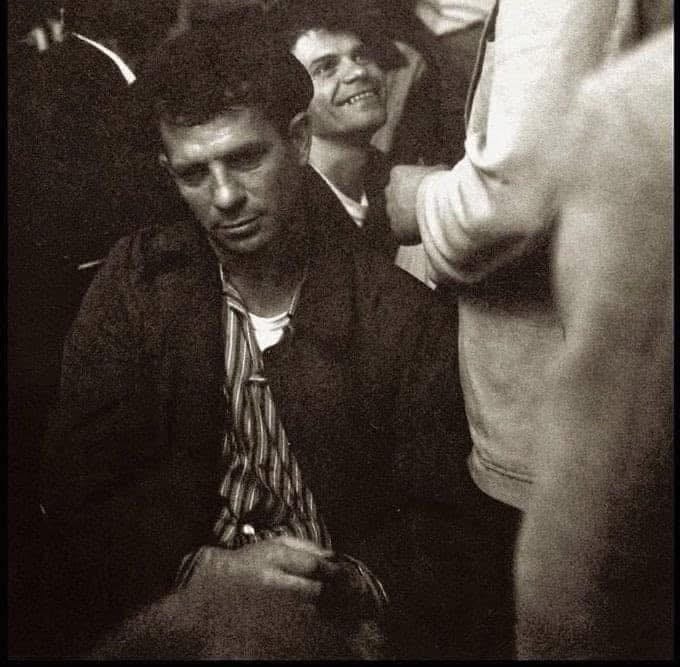
…The five dollars became a gallon of red wine, a loaf of bread, and a chunk of yellow cheese. We drove to the edge of the city, to a hill overlooking the vast, twinkling plain. The lights of Denver were a promise, a dream, a million separate lives we would never know. We passed the wine, the wine glugging in the cold air.
Marylou sat apart, her knees drawn to her chin, staring at the city. “What are we doing, Dean?” she asked, her voice small. “Really doing?”
Dean stopped his manic monologue about the beauty of the Rocky Mountain night and the meaning of IT. He looked at her, really looked, and for a second the mask slipped. I saw the tired, scared kid from the reform school, the ghost in the machine. “Why, darling, “ he said, his voice softening. “We’re living. that’s all. We’re just…living. And when you’re living, you’re digging everything there is to dig, because it’s all part of the great, mad glorious dream.” He put his arm around her, and she leaned into him, a brief, tender moment in the long rush.
We drank until the wine was gone, and the stars turned into one long smeared light. We talked about everything and nothing, our words tumbling into the vast American night. We were together on the road, broke and free, and for that one moment, on a nameless hill under a billion stars, it was everything. It was enough. Then Dean jumped up. “Okay! Now! Let’s go find Roy Johnson! He’ll be at the pool hall! The night is young!” And the moment was gone, shattered by the next frantic impulse, and we piled back into the car, roaring towards the next thing, the holy, beat, and crazy next thing. - Jack Kerouac
What I really love about this wonderful piece of writing is the line right here – “What are we doing Dean?” she asked, her voice small. “Really doing?”
For if ever there was a time when that question was appropriate, it is now. Kerouac wrote this in 1957, the days of the Beats. I was only 7 then, living a sheltered life in Brooklyn. I didn’t know anything, and was a shy bookworm. When my grade school teacher came to my house to visit for some reason, I hid under the table. By the time I became a Hippie, in the next countercultural wave, the freewheeling and wild energy of the Beats was gone. But we had our own beautiful and wild energy, and much of it was turned inward, exploring the inner seas of “Peace and Love, Man.” I was never a drinker like the Beats, but it was at SUNY Geneseo that I had my first times getting high – marijuana, mescaline, then LSD a few times.
I remember going out with friends, wintertime, lovely lovely lovely crystalline world mescaline high, playing in the park outside a museum somewheres, yes we were there, digging it all, playing in the eternal NOW. And riding home in Bill DeLong’s car gazing out the window at early winter sunset gilding with gold the bare trees flashing by, and then a red-gold, as I slowly came back to my semi-miserable self. Oh, the stories I could tell…. an innocent abroad.
And so on we go, to the next crazy thing, one adventure after another, while somewhere there is a hill with billions of stars, waiting for us with the patience of eternity.
It is true that I have a nostalgia for a time that was before, either the time of The Beats, or the Hippies. There was a youthful naïveté then; I am amazed in my recollection of how guileless I was.
And of course Kerouac was the greatest of writers, stringing together sentences, thoughts, feelings, ideas in a torrential rush of pure creative juice. And that brings to mind the rebel’s conundrum – can one live like this without burning out or crashing?
Alas I was too inhibited within myself to even try, too buried to fling it all to the skies in an excess of joyous exuberance and emotion. I thought of myself as the Melancholy Prince. But it didn’t take me too long to see that many of the hippies, despite their outward shows of freedom, peace, and love, were in reality more messed-up than I was. Disillusioned with hippy life, I began my extraordinary journey towards the Eternal within the Ephemeral.
Each day now, I want
to say this –
I am here, in the eye of the world,
in the great wind in the pines
on our nearby mountain.


Each day now, I await
signals,
is it the stories the birds tell?


All of my stories have an end,
a middle, and a beginning,
but yours have none of these.


In your story, where do I place myself?
I take three things, and create
a fourth, – incense, breath, scraps
of ink on paper.


And all this time, I
am being hurled through space,
under a vast sky;
dreaming a life.

 - Josef Skye Tornick
from A Little Book of Hours
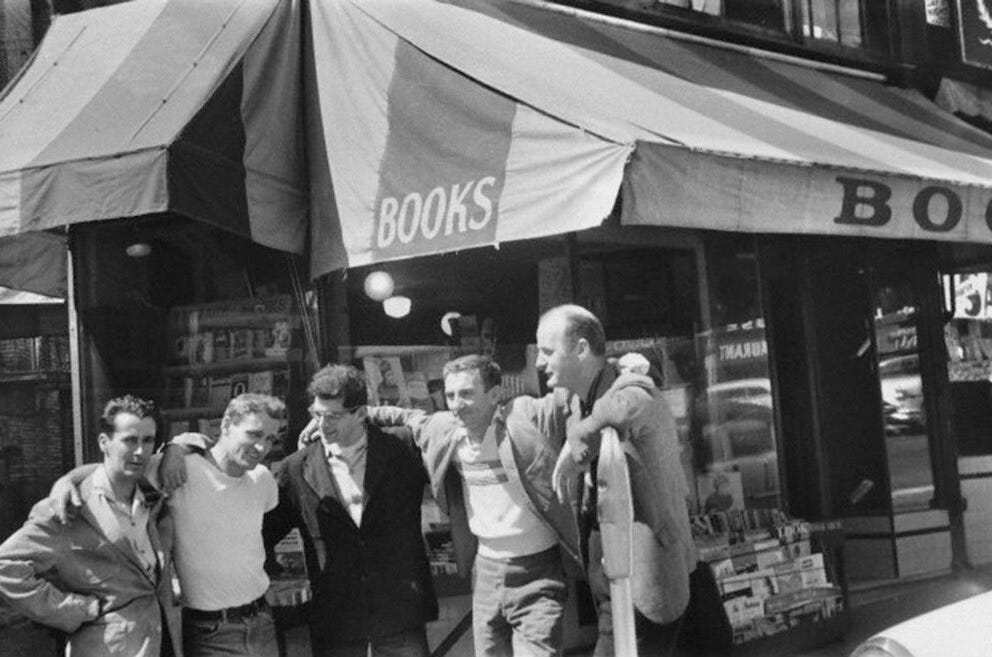
Bob Donlin, Neal Cassady, Allen Ginsberg, Robert LaVigne, and Lawrence Ferlinghetti, in front of City Lights Bookstore, San Francisco, 1955 Foto Allen Ginsberg Corbis.
Joe Landwehr’s Post
My first inclination, in reading this piece by infamous Beat troubadour Jack Kerouac, is to scoff. Cynical me, the one that has survived 75 years of bump and grind, sturm und drang, outlived my own romantic notions about what life was supposed to be, only to crash and burn in the “real” world, again and again, as my innocence collided with something darker, stranger and more insidious than I could imagine, to that me, the thought of “digging everything there is to dig” seems naive. A careless, off-the-cuff observation about life by one who has not yet lived. From the perspective of that me, the Beats, and the hippies that came after them, were starry-eyed, romantic fools, clueless and careless, and ultimately out of touch with the reality in which all of us, one way or the other, have to live. I was one of them once. And then I grew up.
And yet, this is only half the story, for if I am honest with myself, that careless youth is still alive within me, even as the flesh sometimes struggles to keep up with the spirit. This one, ultimately the source of my vitality, my creativity, the willful refusal to settle for anything less that the impossible dream, the starry-eyed utopia we were all promised back then, goddammit, that one is still and always will be reaching for the crazy next thing. Not the crazy next thing that crafty influencers, and corrupt politicians drunk on bold-faced lies, or pandering pundits of every pusillanimous persuasion, would have us reaching for. But the crazy next thing that fires up my own weird and weary imagination, and renders me drunk and helpless at the edge of the Fool’s cliff, leaning too far over the edge, even though the older, ought-to-be-wiser me is certain that catastrophe lies below.
Maybe I’ll leap. Maybe I won’t. The important thing seems to be the reaching itself. To reach, to yearn, to want something, not something found in any thing – but more love, more wild-eyed creative spark, more passion for living regardless of the cost, more of whatever it was we were brave enough to reach for then, and secretly have still not stopped reaching for now – is to be alive.
“He’ll get the sagging, slowly composting body-suit, while we will go on, reaching toward the holy, the sacred, the incomprehensible jaw-dropping crazy next thing on the other side of the veil of mystery.”
Right now, at age 75, I am reaching for a new life in Portugal, leaving everything familiar behind to see what is like to participate in a culture that still revolves around the well being of people, that still functions as a vital democracy, that still puts out the welcome mat for global nomads around the world, looking to reinvent themselves as strangers in a strange land, digging everything there is to dig. Crazy, huh?
As a trial run, I lived there for a couple months this summer, took a language course, connected with the English-speaking ex-pat community, got the lay of the land, and a sense that I could actually do this. Of course, I don’t really know what I’m getting myself into, and I can’t possibly until I’m in the middle of it. But still, I’m reaching for that crazy next thing on the edge of my own imagination, because to reach is to feel alive, excited about being alive, excited about possibilities that give me a deeper, wilder, more compelling reason to live.
To reach no more, to settle, to step back from the thrill of that edge, perhaps especially as we start to slide down that slippery slope called aging, is to court death. We all know that death will win in the end, but if what he gets is only the sagging body-suit we leave behind, while our spirit is still reaching for the crazy next thing, beyond death, whatever that might be, then death’s victory will be hollow. He’ll get the sagging, slowly composting body-suit, while we will go on, reaching toward the holy, the sacred, the incomprehensible jaw-dropping crazy next thing on the other side of the veil of mystery.
So, all innocence, naivete and cynical, jaded judgments about the hapless folly of youth aside, it could just be that the Beats were actually onto something, way beyond their time, which seems quaint, compared to ours, but something that still reverberates in this heart, and maybe in yours. Something that is forever ready to dig the mad, glorious dream because “just living” with whatever we’ve got to give, is still all any of us are really doing here, all that any of us can ever really do at all.
Might as well do it with a bit of wild-eyed panache.
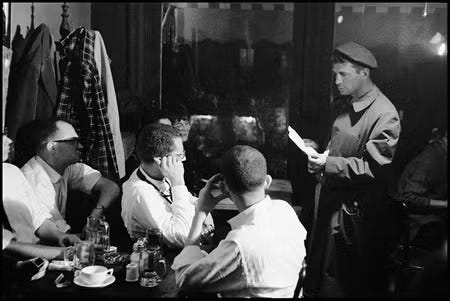
Kerouac Reading